
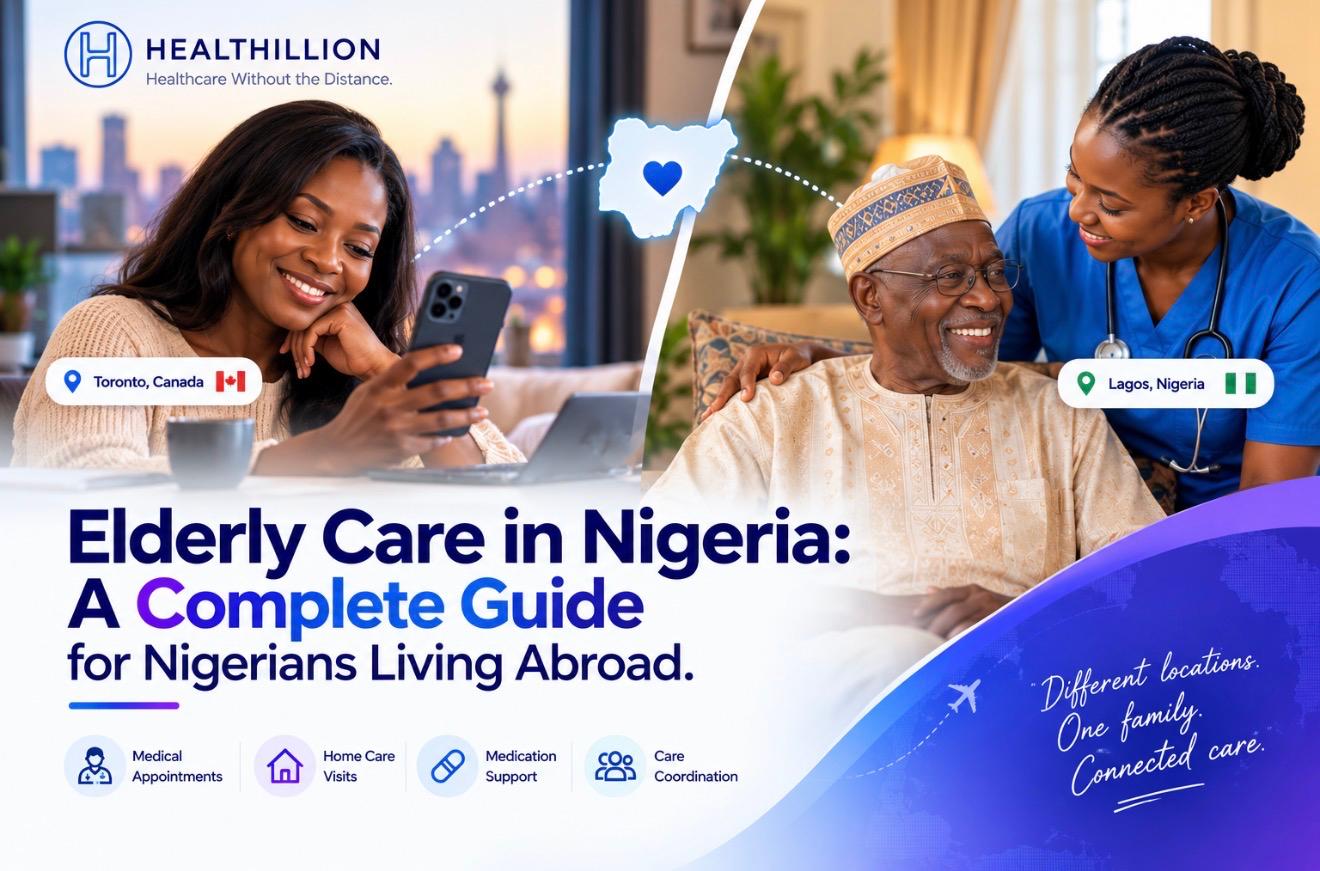
Living abroad can change many things about your life.
But it does not change the moment your phone rings and someone says:
“Mum hasn’t been feeling well.”
Suddenly, London, Toronto, New York, Houston or wherever you happen to be feels very far from Lagos, Abuja, Port Harcourt or your hometown.
You start asking questions.
Has she seen a doctor?
What did the doctor say?
Did anyone collect her medication?
Who is going with her to the follow-up appointment?
Is someone actually checking on her—or is everyone assuming someone else will?
For many Nigerians in the diaspora, supporting parents financially is already part of family life. But as parents grow older, sending money alone may no longer be enough.
What they may increasingly need is coordinated care.
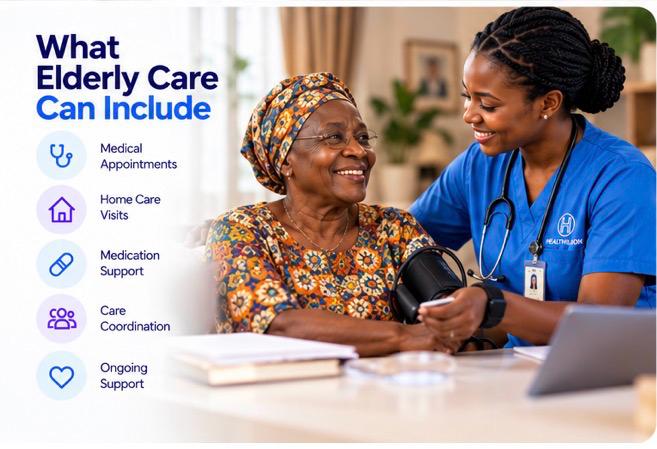
That can mean someone helping arrange medical appointments, checking medications, organizing home visits, communicating with healthcare professionals, following up after appointments and making sure important information reaches the family.
This is where elderly care in Nigeria becomes more than a healthcare issue.
It becomes a family coordination issue.
And when you live thousands of miles away, good coordination can make an enormous difference.
This guide explains what Nigerians abroad should know about caring for aging parents and other elderly loved ones in Nigeria—and how to build a system that gives them appropriate support while helping you stay involved.
Looking for care for a parent or loved one in Nigeria?
Healthillion helps families abroad coordinate healthcare for the people they love in Nigeria—from appointments and home visits to ongoing care and follow-up.
Why elderly care in Nigeria deserves more attention
Nigeria is often described as a young country—and demographically, it is. UNFPA estimates that people aged 65 and older represent about 3% of Nigeria’s population in 2025. But with an estimated total population of 237.5 million, even a relatively small percentage represents millions of older people.
At the same time, families are changing.
Adult children relocate from villages to cities. Others move from Nigeria to the United Kingdom, United States, Canada, Europe, Australia, South Africa and elsewhere.
The traditional model in which several relatives lived close enough to share responsibility for an aging parent becomes harder to maintain.
This is not uniquely Nigerian. WHO notes that many developing countries still depend heavily on households and communities for long-term care. As populations and family structures change, however, the availability of informal caregivers can decline while the need to manage chronic and social care needs increases.
For diaspora families, that creates a particularly difficult situation:
You may be financially responsible for your parent’s care without being physically present to manage it.
And those are two very different responsibilities.
What does elderly care in Nigeria actually mean?
When people hear “elderly care,” they sometimes imagine a nursing home.
That is only one possible model.
For many Nigerian families, elderly care is better understood as a combination of healthcare, daily support and coordination that helps an older person live as safely, independently and comfortably as possible.
Depending on your parent’s health and circumstances, that could include:
- Routine medical appointments and follow-ups
- Home visits by nurses or other appropriate healthcare professionals
- Medication organization and support
- Blood pressure or other clinician-directed monitoring
- Support after hospital discharge
- Help coordinating specialist appointments
- Assistance with mobility and daily activities
- Chronic-condition management
- Nutrition and general wellness support
- Communication between healthcare professionals and family
- Companionship and social support
- Transportation to appointments
- Emergency planning
WHO describes long-term care broadly as services that help people continue living independently and safely when they can no longer perform routine activities entirely on their own.
That distinction matters.
Your 72-year-old mother who lives independently and manages hypertension may need a very different level of support from an 82-year-old father recovering from a stroke.
Good elderly care should therefore start with the individual—not with a generic package.
The hidden problem for Nigerians abroad: fragmented care
Imagine this familiar scenario.
Your father lives in Lagos.
You live in Canada.
He starts complaining about dizziness.
Your sister calls an uncle.
Your uncle recommends a hospital.
Someone arranges transportation.
Your father sees a doctor.
A prescription is written.
Two days later, you ask:
“What did the doctor say?”
The answer?
“They said he’s fine.”
You ask for the diagnosis.
Nobody knows.
You ask what medication he was prescribed.
Someone sends you a blurry WhatsApp photo.
You ask when his follow-up appointment is.
Silence.
This is often not a lack of love.
It is a lack of care coordination.
There may be a doctor.
There may be money.
There may even be several relatives helping.
But nobody has a complete view of what is happening.
That fragmentation is one of the biggest challenges of caring for aging parents from abroad.
1. Start with a clear picture of your parent’s health
Before searching for home care services in Nigeria, first understand what your loved one actually needs.
You do not need to diagnose them yourself. Medical assessment belongs with qualified healthcare professionals.
But your family should organize the basic information that clinicians and caregivers may need.
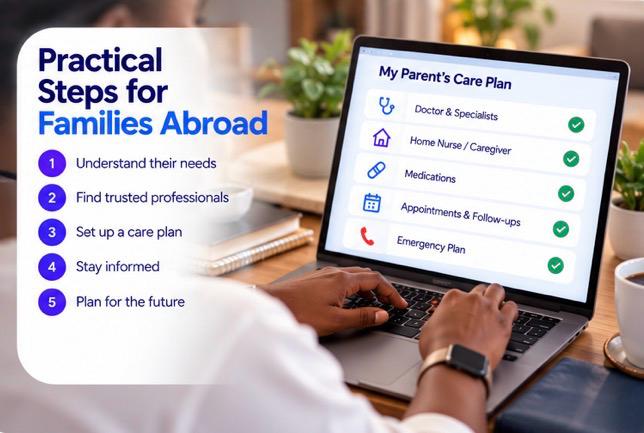
Create a simple care profile containing information such as:
Basic information
Name, age, address, preferred language and emergency contacts.
Existing healthcare professionals
Primary doctor, specialists, preferred clinic or hospital.
Known medical conditions
For example, hypertension, diabetes, arthritis or other diagnosed conditions.
Current medications
Names, doses and schedules where known.
Recent healthcare events
Hospital admissions, procedures, falls or significant changes in health.
Daily living
Can your parent cook, bathe, dress, walk and manage medications independently?
Family concerns
What changes have relatives recently noticed?
This information becomes the foundation of a care plan.
2. Know when an elderly parent may need more support
A parent does not have to be seriously ill before you start planning.
Often, the earliest warning signs are ordinary things.
You may notice Mum repeatedly forgetting medication.
Dad has stopped attending follow-up appointments.
The refrigerator is often empty.
A previously tidy home suddenly looks neglected.
Your parent has fallen more than once.
They seem confused about instructions from the hospital.
They are becoming socially isolated.
Or perhaps nothing dramatic has happened—but every healthcare issue now requires five relatives and twenty WhatsApp messages to resolve.
Those can all be reasons to reassess the support system.
The goal isn’t to take independence away from an older person.
It is to help them maintain independence safely for as long as possible.
3. Understand the difference between a caregiver and a home care nurse
This is one of the most important distinctions for diaspora families researching home care for elderly parents in Nigeria.
A caregiver and a nurse are not interchangeable.
A caregiver may help with everyday activities
Depending on their training and role, this can include companionship, meal support, mobility assistance, personal care and other non-clinical activities.
A registered or appropriately licensed nurse provides clinical nursing care
Depending on professional scope, the patient’s needs and clinician instructions, nursing support may include clinical assessments, wound care, monitoring, medication-related nursing tasks, post-discharge support and communication with the wider clinical team.
If your parent primarily needs companionship and daily-living assistance, a non-clinical caregiver may be appropriate.
If they have medical needs requiring nursing skills, you may need a qualified home care nurse in Nigeria.
Some families need both.
Before hiring anyone, clearly establish:
What does my parent need this person to do?
Then make sure the professional’s qualifications and permitted scope match those needs.
4. Verify healthcare professionals—don’t rely only on recommendations
Nigeria runs heavily on referrals.
“My friend’s sister knows one nurse.”
That can be a useful starting point.
It should not be the entire verification process.
When arranging elderly home care from another country, ask questions about the professional or organization providing care.
What qualifications does the person hold?
Is any required professional registration or licence current?
What experience do they have with elderly or home-based care?
Who supervises the care?
What happens if the regular professional is unavailable?
How are visits documented?
How does the family receive updates?
How are complaints handled?
How is patient information protected?
What happens if the patient’s condition deteriorates?
Trust is essential in elderly care.
But trust should be supported by verification and accountability.
5. Build one coordinated healthcare team
Older adults can accumulate healthcare professionals quickly.
A primary care doctor.
A cardiologist.
An ophthalmologist.
A pharmacist.
A physiotherapist.
A home nurse.
A hospital consultant.
Each may be doing their job correctly while the family still struggles to understand the overall picture.
That is why care coordination in Nigeria can be particularly valuable for diaspora families.
A care coordinator or care manager can help connect the moving pieces—appointments, home visits, follow-ups, information and family communication—rather than leaving the person abroad to manage everything across time zones.
Think of it this way:
You don’t necessarily need more people involved.
You need the people already involved to work as a connected system.
6. Create a medication system before there is a problem
Medication is an area where casual family coordination can become risky.
Avoid changing, stopping, doubling or substituting prescription medicines without guidance from an appropriate healthcare professional.
Instead, help establish a reliable system.
Maintain an up-to-date medication list.
Know which clinician prescribed each medication.
Use one consistent schedule where appropriate.
Have a process for refills before medicines run out.
Ensure the family knows where prescriptions are being filled.
Ask the relevant healthcare professional or pharmacist about possible concerns if your parent uses several medications.
And importantly, periodically verify that the medication list is still current.
A WhatsApp message saying “Mum has taken her drugs” is reassuring.
A coordinated medication process is much better.
7. Don’t wait for an emergency to decide where your parent will receive care
Diaspora families often spend enormous energy planning flights, schools, mortgages and retirement—but have no healthcare contingency plan for parents back home.
Create one before you need it.
Know your parent’s usual healthcare facility.
Know where they should seek urgent or emergency care locally.
Keep emergency contacts accessible.
Know who can physically reach your parent quickly.
Keep essential health information organized.
Make sure relevant family members understand the plan.
And don’t treat a remote care platform, WhatsApp conversation or scheduled home visit as a substitute for emergency medical services.
If your loved one develops symptoms that may represent a medical emergency, they should seek appropriate local emergency care promptly.
8. Make communication part of the care plan
For Nigerians abroad, this can be almost as important as arranging the appointment itself.
You need a predictable answer to:
“How will I know what happened?”
With the patient’s appropriate consent and subject to privacy requirements, decide:
Who receives updates?
After which events?
How quickly?
Through what channel?
What information should be documented?
Who is responsible for follow-up?
A useful care update might say:
Appointment completed → clinician recommendations recorded → prescription obtained → follow-up scheduled → family updated.
That is much more actionable than:
“Daddy went to hospital. Everything is okay.”
9. Talk to your parents, not just about them
This is easy to overlook when you’re worried.
Your parent is still the central person in the care relationship.
Ask what they want.
Some parents may welcome a nurse visiting regularly.
Others may initially resist.
Some may interpret extra support as their children deciding they are no longer capable.
Instead of:
“Mummy, we’re sending someone to watch you.”
Try:
“Mummy, I want to make things easier so you don’t have to handle every appointment and medication by yourself. What kind of help would make you most comfortable?”
Respect, autonomy and dignity should remain part of the plan.
Ageing does not erase a person’s right to participate in decisions about their own life.
International guidance on ageing similarly emphasizes health, dignity, participation and supportive environments for older people.
10. Budget for care—not just emergencies
Many diaspora families have a reactive healthcare budget.
Something happens.
Someone calls.
Money is transferred.
Treatment happens.
Then everyone waits until the next problem.
A more sustainable approach is to estimate recurring healthcare needs.
That might include:
- Routine consultations
- Medication
- Laboratory tests when clinically indicated
- Home nursing or caregiving
- Transportation
- Specialist appointments
- Care coordination
- Insurance or health-plan costs where applicable
- Emergency reserves
Nigeria’s health-financing system continues to evolve. The National Health Insurance Authority Act was enacted in 2022, and the NHIA also operates a Vulnerable Group Fund intended to help subsidize healthcare for qualifying vulnerable people. Eligibility and available coverage should be confirmed directly with NHIA or the relevant programme.
The key principle is simple:
Don’t assume paying a subscription, insurance premium or care-coordination fee automatically covers every consultation, medication, test or hospital bill.
Ask exactly what is included and what remains separate.
What does good elderly home care in Nigeria look like?
Whether you’re looking for elderly care in Lagos, Abuja or elsewhere in Nigeria, quality care should feel organized rather than chaotic.
A strong system generally has:
A known care plan — everyone understands the main needs and responsibilities.
Qualified professionals — clinical tasks are performed by appropriately trained and authorized people.
Clear accountability — you know who is responsible for what.
Regular communication — important changes don’t disappear into family WhatsApp groups.
Continuity — care doesn’t restart from zero every time a new problem appears.
Respect for the older person — care is done with them, not simply to them.
Escalation processes — everyone knows what to do when needs become urgent or exceed home care.
Family visibility — where consent and privacy requirements allow, relatives abroad can understand important developments.
That is the difference between simply paying for healthcare and actually managing care.
A practical checklist for Nigerians caring for parents from abroad
Save this list.
Before you finish setting up your parent’s care, make sure you can answer these questions:
- Who is my parent’s main healthcare professional?
- What diagnosed conditions are currently being managed?
- What medications are they taking?
- Where do they normally receive healthcare?
- Who accompanies them when necessary?
- Do they need clinical home nursing, non-clinical caregiving, or both?
- Who coordinates appointments?
- Who follows up after appointments?
- Who obtains medication or assists with refills?
- How will I receive updates?
- Who can physically reach them quickly?
- What is the plan for urgent or emergency situations?
- Are healthcare professionals appropriately verified?
- Does my parent understand and agree with the care arrangement?
- Who has responsibility for keeping the overall plan current?
- If several answers are “I’m not sure,” your family may not have a money problem.
You may have a coordination problem.
And coordination can be fixed.
How Healthillion can help families across borders
Living abroad shouldn’t mean choosing between building your life overseas and being involved in your parents’ healthcare at home.
That’s the problem Healthillion is designed around.
Healthcare Without the Distance.
Healthillion helps families connect their loved ones in Nigeria with healthcare professionals and coordinate aspects of their care—so the family member overseas doesn’t have to manage every appointment, home visit and follow-up alone.
Depending on the services available and your loved one’s needs, coordinated support can help with areas such as appointments, home-care visits, nursing support, medication-related coordination, follow-ups and family communication.
The goal isn’t to replace the family.
It is to make the family better connected to the care already happening on the ground.
You may be abroad. Your support doesn’t have to feel far away.
If your mother, father or another loved one in Nigeria needs more organized healthcare support, start by telling us what they need.
Frequently Asked Questions About Elderly Care in Nigeria
How can I take care of my elderly parents in Nigeria while living abroad?
Start by understanding their health and daily-living needs, identifying their healthcare professionals, organizing medications and appointments, establishing a reliable local support person or professional, and creating a consistent system for updates. If managing these pieces yourself becomes difficult, a care-coordination service can help connect them.
Can I arrange home care for my parent in Nigeria while overseas?
Yes. The appropriate type of care depends on your parent’s needs and the availability of services in their location. Determine whether they need non-clinical caregiving, clinical nursing, appointment coordination or a combination, and verify the qualifications of anyone providing professional care.
How do I find a home care nurse in Nigeria?
Look for appropriately qualified nurses or reputable healthcare organizations, verify required professional credentials, ask about experience with elderly/home care, understand how visits are supervised and documented, and establish how concerns will be escalated.
How much does elderly home care cost in Nigeria?
Costs can vary significantly according to location, frequency and duration of visits, professional qualifications, the complexity of the person’s needs and whether support is occasional or ongoing. Request a clear breakdown of what is included before agreeing to a service.
Is home care the same as hospital care?
No. Home care can support many ongoing needs, but it does not replace hospital or emergency services when those are medically necessary.
What if my parent already has a primary care doctor?
That’s useful. Rather than unnecessarily replacing existing healthcare relationships, care coordination can potentially help connect appointments, home support, medication needs and follow-ups around the clinicians your parent already knows, where appropriate.
When should I start arranging elderly care?
Ideally, before a crisis. If your parent is missing appointments or medications, struggling with daily activities, experiencing repeated falls, becoming more isolated, needing increasing family assistance or managing multiple healthcare needs, it may be time to discuss additional support with them and appropriate healthcare professionals.
Distance changes how you care. It doesn’t change how much you care.
There is a particular kind of worry that comes with loving someone from another country.
Your phone rings at an unusual hour and your mind immediately goes home.
For millions of families around the world, migration and remittances remain an important part of supporting loved ones across borders. The World Bank notes that migrants commonly send money back to families and communities; across low- and middle-income countries, officially recorded remittances were estimated at hundreds of billions of dollars annually.
But as our parents grow older, the next evolution of diaspora support may need to be about more than sending money.
It may be about building reliable systems of care.
Knowing someone checked on Mum.
Knowing Dad made his appointment.
Knowing what happened afterward.
Knowing who is following up.
And knowing that even though you can’t always be there physically, your family doesn’t have to navigate healthcare alone.
That is what elderly care in Nigeria for diaspora families should ultimately provide:
Not control.
Not endless phone calls.
Not another complicated system.
Connection, continuity and peace of mind.
Healthcare Without the Distance
You can’t always be there in person.
You can still be there for them.
Healthillion helps families abroad coordinate healthcare for loved ones in Nigeria and stay connected to the care that matters.
Find Care for a Loved One →
Talk to Our Care Team →
Different locations. One family. Connected care.
Medical note: This article provides general educational information and is not medical advice or a substitute for diagnosis, treatment or emergency care from qualified healthcare professionals. Service availability, professional scope and healthcare costs can vary by location and individual circumstances.
Worried About a Parent in Nigeria?
Tell us what kind of support they need. Healthillion can help you coordinate trusted care from wherever you are.
Find Care for a Loved One